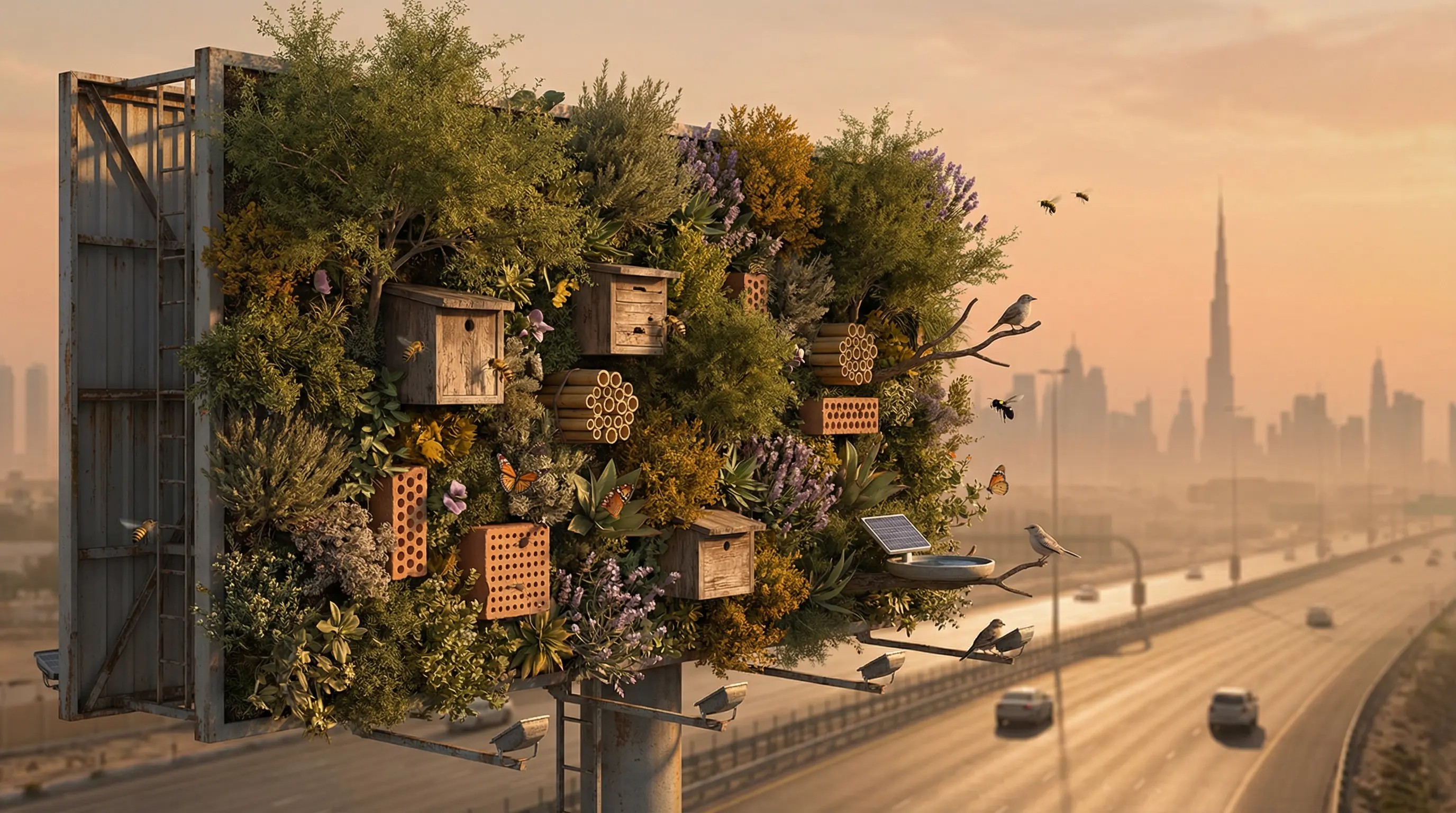
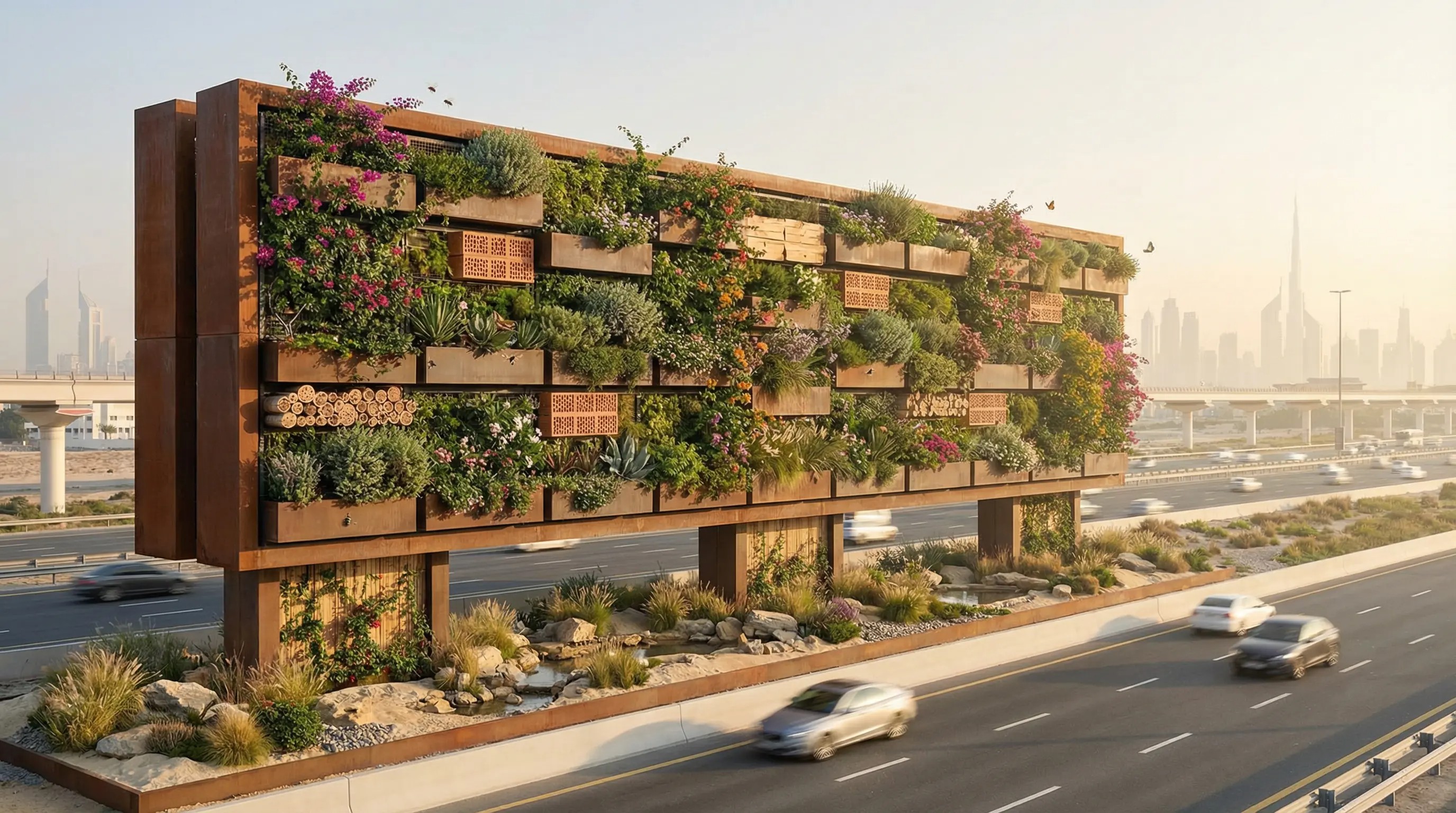
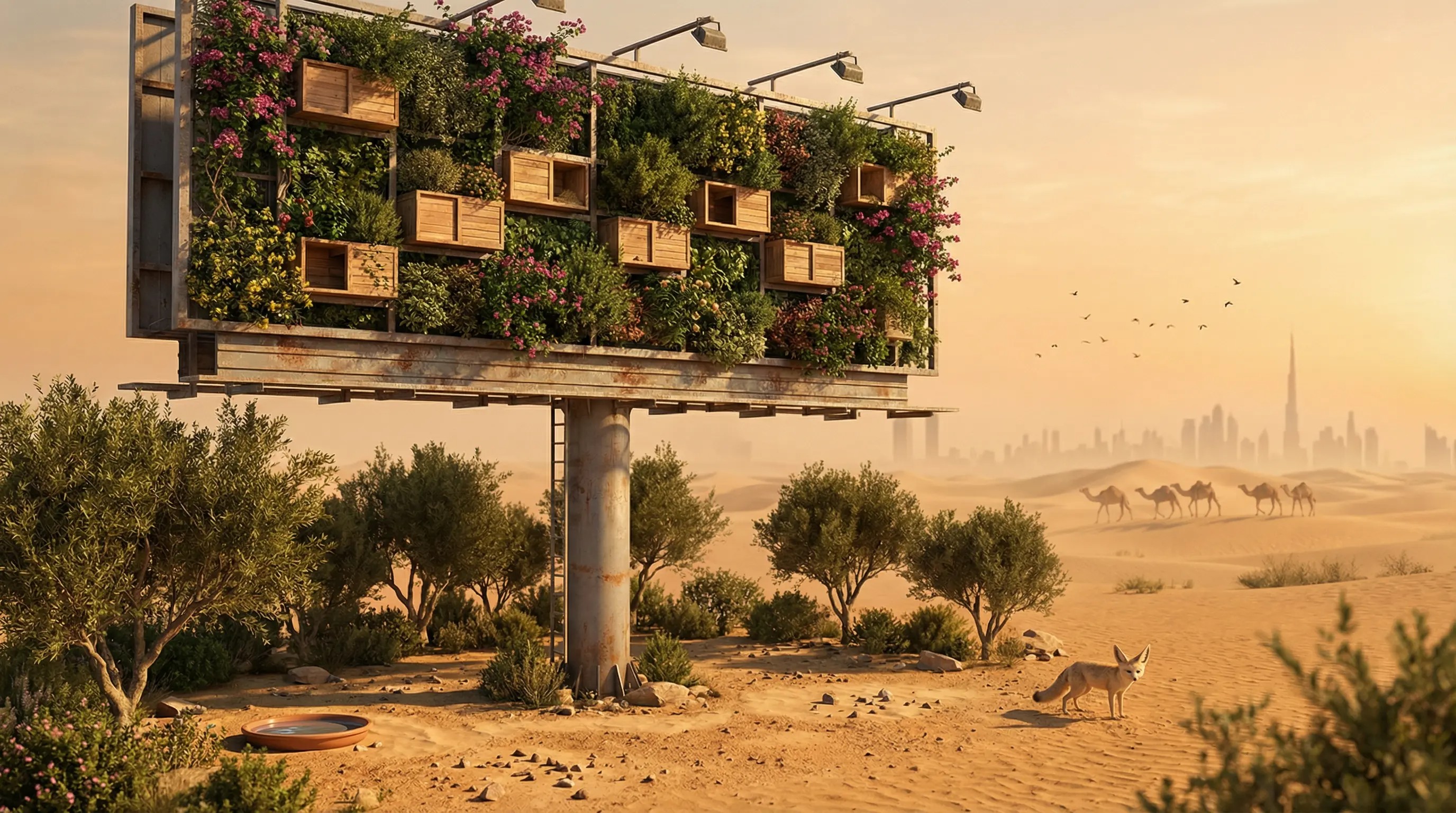
The UAE's first regenerative billboard. Not an advertising structure with sustainability branding. An actual insect habitat — built at billboard scale — that supports 40,000 to 60,000 native pollinators while carrying a brand message.
The UAE's outdoor advertising industry runs on vinyl — a material that contributes nothing ecologically, takes centuries to decompose, and leaves no trace of value when the campaign ends. Thousands of square metres of it are discarded annually. Billboard structures sit in some of the most ecologically sensitive landscapes in the country. And they give nothing back.
Governments and brands are increasingly seeking authentic, measurable sustainability projects. Not greenwashing. Not offsets. Genuine ecological impact embedded into the commercial infrastructure of a city.
No blueprint for this exists. Until now.
The Desert Hive Billboard is a full-scale advertising structure designed as a living insect hotel — the first of its kind in the UAE and the Middle East. The structure provides nesting modules for native solitary bees and beneficial insects, built from terracotta, FSC wood, bamboo, and eco-concrete.
It carries a brand message. It also supports 40,000 to 60,000 pollinators. Over 75% of flowering plants rely on pollinators. In the UAE, native solitary bees and beneficial insects are essential for the survival of Ghaf trees, Sidr, desert marigold, and countless desert species. Urban development has stripped away nesting sites — but cities can become powerful refuges when micro-habitats are added intentionally.
A QR code embedded in the habitat structure gives public access to real-time species data, seasonal pollinator activity, and citizen science observation tools. The billboard that usually asks people to buy something instead invites them to look — at what is living, and why it matters.
Komorebi is the originator, designer, and pitch architect for this concept. Currently seeking visionary investors and partners to bring the UAE's first Regenerative OOH structure to life.
Native solitary bees, beneficial insects, and UAE-specific pollinator species — supported through terracotta nesting cells, bamboo stems, and hardwood cavities.
Covers engineering, ecological design, prototyping, fabrication, installation, impact measurement, and PR activation for the MVP.
No competitor currently offers regeneration-based billboard assets. Komorebi creates the category and holds the first-mover advantage.
Every material chosen for structural integrity, climate resilience, and ecological suitability to UAE conditions — thermal mass, natural ventilation, shade, and moisture retention designed for desert summers.
Nesting cells for solitary bees — naturally porous, thermally stable, and ecologically proven across global insect hotel research.
Structural frame and cavity nesting material — sustainably sourced, with natural ventilation cavities sized for UAE native species.
Hollow stems — ideal for solitary bee nesting. Pre-cut to species-specific diameters, climate-dried for UAE heat tolerance.
Base structure and mounting — low-carbon concrete blend providing the structural foundation for a permanent installation.
Visualisations of the Desert Hive Billboard at proposed sites — billboard scale, integrated terracotta nesting cells, and the planted base that anchors it to the desert it serves. These are the conversations we're having with developers and brands right now.
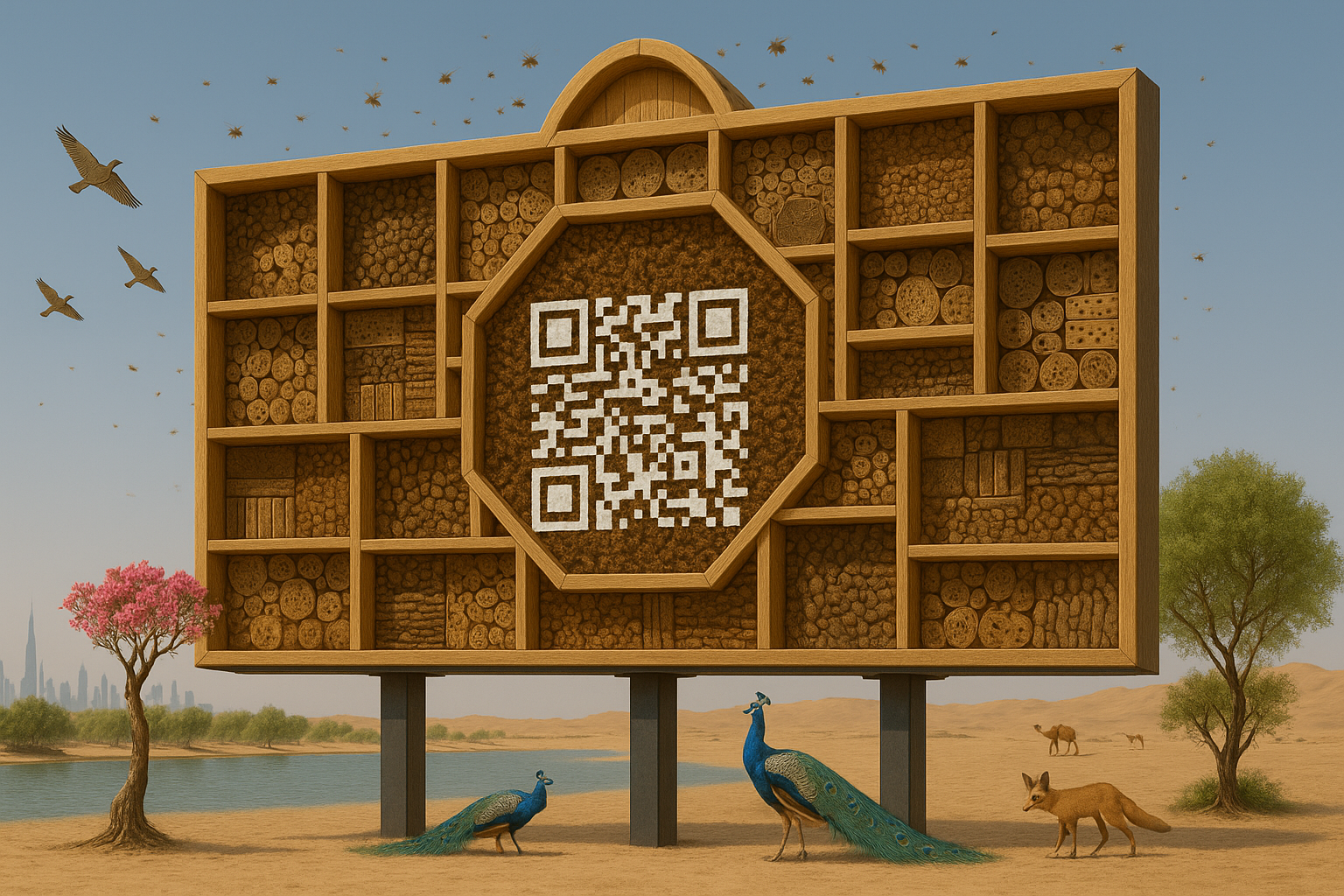
Plate 01 · Hero render
Plate 02 · Context
Plate 03 · Detail
Plate 04 · Environmental view
Fully functional pilot structure at a high-visibility site — city edge, eco-development, or desert entry. Proof of concept. Commercial prototype. First mover established.
Regenerative billboard leasing to brands. Co-branded partnerships with government environment and tourism entities. Licensing the design to other OOH operators across the GCC.
Citywide Desert Hive Billboard network. Educational and citizen science extensions. Micro-habitat products for schools, parks, and developers. A category that becomes infrastructure.
The Desert Hive Billboard is not a campaign. It is a new standard — for what advertising infrastructure can be, what brands can stand for, and what cities can choose to build.
Dubai is a city of world firsts. This would be one of the most meaningful. A structure that produces ecological value instead of consuming it. A brand asset that becomes a landmark. A billboard that the bees move into.
Komorebi is seeking visionary partners — investors, developers, government entities, and brands with genuine climate commitments — to bring this concept to life. The category is open. The design is ready. The desert is waiting.